

Types of Warehouse Storage: Which Model Fits Your Catalogue?
Pallet racking, shelving, mezzanines and mobile systems all suit different catalogues. Here is how storage type shapes cost, access and picking speed.
By The Juvo team — 11 August 2026
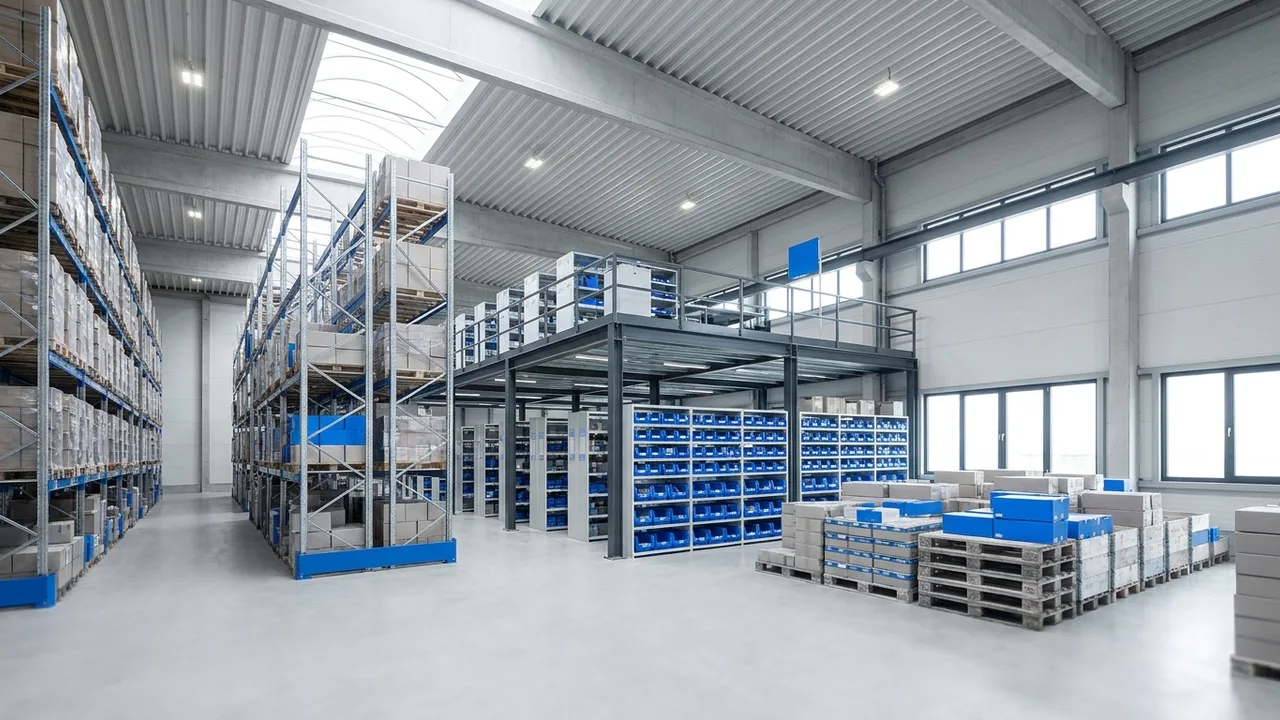
TL;DR: Storage type is not a detail, it decides how fast your orders move and how much space you actually pay for. Pallet racking suits full-pallet volume, shelving suits small-part picking, and mezzanines add a level without adding a building. The right mix depends on your SKU count, how fast stock turns, and whether you ship pallets or parcels.
Most businesses think about warehousing as a question of square metres. How much space do we need, and what does it cost per month?
That question skips the part that actually drives your logistics bill. Two operations can rent identical floor space and get completely different results, because the storage systems inside them suit different catalogues. A pallet rack layout built for fast-moving bulk stock will strangle a business picking single spare parts, and a shelving-heavy layout will waste money on a brand shipping full pallets to retailers.
Whether you sell direct to consumers online or supply other businesses, here is how the main storage types differ and what each one is good at.
What Are the Main Types of Warehouse Storage?
Most warehouses combine a handful of systems rather than picking just one. The common ones are pallet racking, multi-tier racking, static shelving, mobile shelving and mezzanine flooring, each suited to a different product size and picking pattern.
Pallet racking handles goods that arrive and move in bulk. Shelving handles small items picked individually. Mezzanines add a working level above the floor.
The mix matters more than any single choice. A catalogue with both bulky items and small components needs both, zoned so that pickers are not walking the length of the building for one order.
Which Racking Type Suits Your Stock?
Racking is not one product. The six common types are selective, double-deep, drive-in, push-back, pallet flow and cantilever, and the right one depends on your SKU count, whether stock rotates first-in-first-out or last-in-first-out, ceiling height and forklift type.
Selective racking is the usual starting point. It gives direct access to every pallet, which is what you want when you carry many different references and pick from a lot of them.
Density is the trade-off. Double-deep racking stores pallets two positions deep and raises density by roughly 20 to 30 percent, but the front pallet has to move before you can reach the one behind. That works when you hold several identical pallets per reference, and it hurts when you hold one.
For businesses with deep catalogues and single-unit references, access beats density almost every time. That is the same logic behind managing a high-reference catalogue well.
How Does Storage Type Affect Picking Speed?
Directly. Every metre a picker walks and every pallet they have to move first is time added to an order, so storage layout sets a ceiling on how fast you can dispatch.
This is why small-part picking usually gets its own zone. Warehouses typically keep a dedicated shelving area for small picks close to packing and shipping, rather than sending pickers into the pallet aisles for a single component.
Density systems help here too when the profile fits. Mobile shelving, which rolls on tracks and opens one aisle at a time, can raise storage density by up to 50 percent in small-parts and high-reference environments.
Dedicated Space or Shared Space?
Beyond the racking itself, there is the question of whether your stock sits in its own area or shares a facility with other businesses.
A dedicated arrangement typically means partitioned space, assigned dock doors, a dedicated labour pool, custom slotting and inventory that never mixes with anyone else’s. It buys control, and you pay for the space whether you fill it or not.
Shared space flexes with your volume instead. For most growing e-commerce brands and for B2B businesses with seasonal swings, that flexibility is worth more than exclusivity, particularly if your peak looks nothing like your quiet months.
Where Businesses Get It Wrong
The most common mistake is choosing storage for today’s catalogue and never revisiting it. Reference counts grow, order profiles shift from pallets to parcels, and a layout that fitted two years ago quietly starts costing money.
The second is paying for space you cannot use. Poorly designed racking can waste up to 20 percent of usable cube, which is rent on storage that holds nothing.
The third is ignoring slow stock. References that barely move still occupy prime positions unless someone re-slots them, which is why slow-moving stock quietly inflates warehousing costs.
Getting the Mix Right
There is no single best storage type, only a mix that matches your catalogue, your order profile and how fast things turn. Deep catalogues need access. Bulk volume needs density. Most businesses need both, properly zoned.
At Juvo, we handle storage across our French warehouse network for e-commerce brands and B2B businesses alike, with real-time stock visibility and slotting built around each catalogue. Clients working with us see 18 percent lower logistics costs and 25 percent better delivery performance.
Talk to us about your storage and stock management and we will map the right setup for your references.
Frequently Asked Questions
What are the main types of warehouse storage? The most common are pallet racking, multi-tier racking, static shelving, mobile shelving and mezzanine flooring. Most operations combine several, because bulky goods and small individually picked items need different systems.
What is the difference between selective and double-deep racking? Selective racking gives direct access to every pallet position. Double-deep stores pallets two deep, raising density by roughly 20 to 30 percent, but you must move the front pallet to reach the one behind. Selective suits varied catalogues; double-deep suits multiple identical pallets per reference.
Is dedicated warehouse space better than shared space? It depends on volume stability. Dedicated space gives partitioned storage, assigned docks and a dedicated team, but you pay for it whether you fill it or not. Shared space flexes with demand, which usually suits growing or seasonal businesses better.
How does storage type affect order picking speed? It sets the distance pickers travel and how many movements each pick takes. Small-part picking is usually zoned near packing, while high-density systems that require moving stock to reach other stock slow down catalogues with many single-unit references.
How much warehouse space is typically wasted? Poorly designed racking can waste up to 20 percent of usable cube space, meaning you pay rent on storage that holds nothing. Reviewing layout as your catalogue changes is the practical fix.