

Setting Up an E-commerce Warehouse: What Actually Matters
What makes an e-commerce warehouse work: layout, picking flow, peak-season buffer, and when a dedicated e-commerce warehouse beats a general one.
By The Juvo team — 18 June 2026
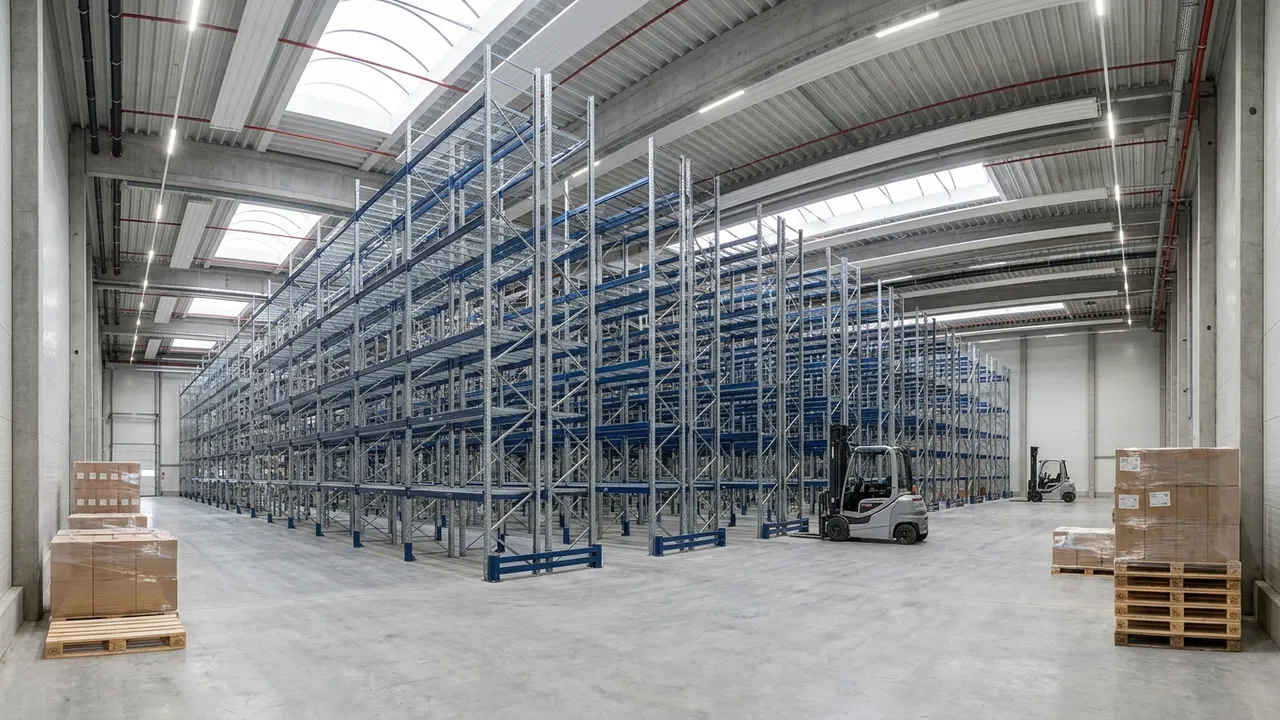
TL;DR: An e-commerce warehouse is built around small, frequent orders rather than bulk pallets, so its layout, picking flow, and storage need different rules from a traditional warehouse. This guide covers what actually matters when setting one up: layout, pick paths, peak-season buffer, and when it makes sense to hand the whole thing to a specialist.
A warehouse built for e-commerce does a fundamentally different job than one built for wholesale. Instead of loading full pallets onto lorries, it handles hundreds or thousands of small, individual orders, each needing to move from shelf to box to courier as fast as possible. Get the layout wrong and every order takes longer, costs more, and carries a higher risk of error. Get it right, and speed and accuracy become the default rather than the exception.
What Makes E-commerce Warehousing Different?
E-commerce warehousing is built around high order volume and small basket sizes rather than large, infrequent shipments. Most orders contain only one or two lines, but there are far more orders to process than in a traditional bulk warehouse, so the layout has to prioritise fast, accurate access to every SKU rather than efficient pallet storage.
This changes what “efficient” means. A traditional warehouse optimises for moving large quantities with minimal handling. An e-commerce warehouse optimises for picking speed and order accuracy across a high number of small, separate transactions, which calls for a different storage and picking strategy from the ground up.
How Should the Layout Be Organised?
A good e-commerce warehouse layout minimises unnecessary movement while keeping enough stock on hand for both everyday demand and peak periods. Every metre of warehouse floor is expensive, so the layout has to strike a balance between storage capacity and fast, easy access to fast-moving items.
Placing your highest-selling products closest to the packing area is one of the simplest wins available. Pick paths that loop without crossing back on themselves save real time across thousands of picks a day. Reliable storage and stock management is what keeps that structure working as volume grows, rather than degrading into ad-hoc shelving decisions.
What Picking Strategy Actually Works?
The right picking strategy depends on order volume and how much overlap exists between orders, not on a single best method. Batch picking, where a picker collects items for several orders in one pass through the warehouse, can cut walking time by 30 to 40 percent compared to single-order picking, making it a strong default for operations with many small, overlapping orders.
For larger warehouses with a wide product range, zone picking often works better: each picker is responsible for one area, and orders pass from zone to zone until complete. Picking labour typically makes up 50 to 60 percent of total warehouse labour cost, so getting this choice right has a direct effect on your margin, not just on speed.
How Do You Handle Peak Season Without Breaking the Layout?
Peak season needs a warehouse layout that can flex without a full redesign. E-commerce demand swings far more sharply between an average week and a peak period than traditional wholesale demand does, and the layout has to leave room for that swing rather than being built purely around average-day volume.
This usually means holding back some flexible storage capacity rather than filling every shelf to its limit, so extra stock has somewhere to go without disrupting the pick paths already in place. E-commerce operators typically see much larger swings between everyday and peak demand than traditional warehouses do, which is exactly why that spare capacity matters. It also means keeping returns handling built into the same layout, since returns volume rises with order volume and a return that has no clear place to go slows down the whole operation.
When Does a Dedicated E-commerce Warehouse Beat a General One?
A dedicated e-commerce warehouse earns its keep once order volume and SKU count both climb high enough that a general-purpose space starts working against you. Below that point, a smaller or shared space can manage well enough. Above it, the mismatch between bulk-storage layouts and small-order picking starts costing real time on every single order.
For a growing e-commerce brand or a distribution business managing a demanding catalogue, this is often the point where building the expertise in-house costs more than partnering with a specialist who already runs this kind of operation daily. See how this works for your sector on our e-commerce solutions page.
Conclusion
An e-commerce warehouse succeeds or fails on the same few decisions: a layout built for small, frequent orders, a picking strategy matched to your actual order pattern, and enough flexible capacity to absorb peak season without falling apart. Get these right and fulfilment becomes a quiet, reliable part of the business rather than a daily fire to fight. If building and running this in-house is stretching your team thin, ask us for a quote and we will show you how a connected warehouse operation works.
Frequently Asked Questions
What is the biggest difference between an e-commerce warehouse and a traditional one? An e-commerce warehouse handles many small, separate orders rather than large bulk shipments, so its layout and picking strategy prioritise speed and accuracy across high order volume instead of efficient pallet storage.
What picking method is best for an e-commerce warehouse? It depends on order volume and overlap between orders. Batch picking suits operations with many small, overlapping orders, while zone picking suits larger warehouses with a wide product range, since it limits how far each picker has to travel.
How much storage capacity should be left free for peak season? Enough flexible capacity should be held back to absorb a sharp rise in order volume without disrupting existing pick paths. E-commerce demand swings more sharply between average and peak periods than traditional wholesale demand, so building only for average-day volume creates problems at exactly the wrong time.
Why does returns handling need to be part of the warehouse layout? Returns volume rises alongside order volume, and a return with no clear place to go slows down picking and restocking for the whole warehouse. Building returns handling into the layout from the start keeps the operation running smoothly during busy periods.
When is it worth outsourcing e-commerce warehousing to a 3PL? Once order volume and SKU count reach a point where a general-purpose space works against efficient picking, partnering with a specialist 3PL is often more cost-effective than building the same expertise and infrastructure in-house.